Skip to content
ANNA BON

Energy.

AI Is an Energy Story

By
Anna Bon
Category
Energy
Form
Essay
Length
9 min read
Published
2026-07-20

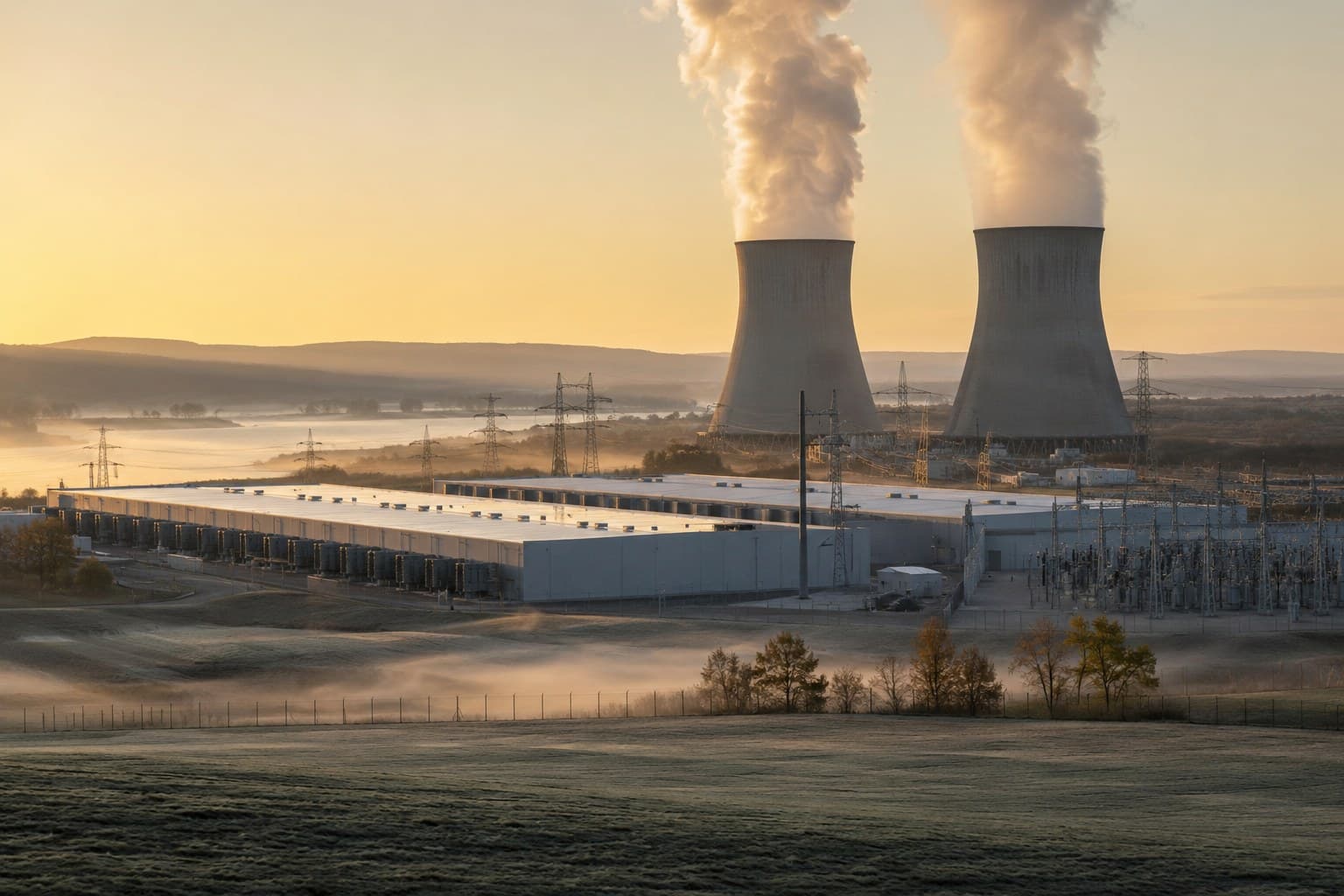
At VivaTech in Paris the head of Nvidia repeated a formula I have been saying for years: a data centre is a power station.

It simply produces intellect rather than current.

That is not a metaphor, it is a procurement specification. The trillions of capital now moving into artificial intelligence are looking for three physical things and nothing else: land, cooling, and cheap stable electricity. Mistral put €1.2 billion into a 23-megawatt facility in Sweden, which is €52 million per megawatt. Global data-centre consumption will more than double by 2030, to around 945 terawatt-hours a year. This is the part of the AI story that cannot be written in software, and it is the part where Ukraine — with atomic generation, an engineering school, the largest gas storage in Europe and a border with Europe's biggest market — is not a spectator.

London. Two days at a run, and the most expensive negotiations of my life began with the question would you like tea?

JP Morgan holds over $4 trillion in assets. I worked out that this is 1.7 trillion bowls of borshch — enough to feed all humanity daily and still have two hundred years left over. We were not talking about borshch. We were talking about why Ukraine is water in a desert, and why the world is about to start fighting over it.

Then Saudi Aramco, effectively the wealthiest company on the planet, an energy giant with more money than some continents. Honestly, even for me this was a new level. The conversations there are not about millions but about trillions, and not about business but about the physical future of civilisations.

British hospitality is austere: four hours of investment declarations and very strong tea. The only thing in London firmer than that tea is their certainty that the world is about to collide with an energy famine caused by artificial intelligence.

I was there representing my own fund, which is already building data centres and new energy in Europe. But at every table I also described the Ukrainian economic movement, and it is that which impresses even the bankers.

If anyone thinks billions in investment are waiting on Khreshchatyk with a suitcase — they are not. You have to go to them. And these people do not believe in slogans. They believe in usefulness and in figures. So let us take the figures.

China built 543 gigawatts of new generating capacity in 2024. What some countries built across decades, in a single year.

The United States is putting $500 billion into AI infrastructure through Stargate. That is Trump's programme — not the Democrats', not the Republicans'. It is a state strategy.

OpenAI will spend $600 billion on computing capacity by 2030. Reuters, yesterday. That is four years of Ukraine's entire GDP.

Mistral, the French competitor to ChatGPT, last week put €1.2 billion into a data centre in Sweden. Capacity: 23 megawatts. Which comes out at €52 million per megawatt. Remember that number.

Global energy consumption by data centres will more than double by 2030, to 945 terawatt-hours a year.

Do you still think this is a bubble and a game for the chosen few? It is not a business. It is a new technological cycle, and it will determine who is wealthy for the next fifty years. History repeats.

Either you are at the table, or you are on the menu.

Whoever owns energy and computation owns the money of the next fifty years.

And who understood that fastest? The oil monarchies of the Gulf. Aramco and the funds of the Emirates and Dubai were among the main sponsors of the forum, putting hundreds of billions of sovereign money into data centres. They are building the future. For several ruling families.

We have everything needed to become a player in this new economy: gas, the largest storage capacity in Europe, atomic generation, sun. And sixty million Ukrainians across the world who are tired of being the workforce on somebody else's contract. The sheikhs are building a fund for a throne. We could build a fund for a nation.

At this point people stop me with four objections, and they are fair ones. Here is what I answer.

Missiles. A data centre is a target. Decentralisation and underground construction — an idea our own military suggested to me. Outside Helsinki, in granite rock, sits one of Scandinavia's largest data centres. Israel has been building that way for forty years. Ten small facilities distributed across the country is a task orders of magnitude harder for an enemy than one address. That is engineering, not fantasy.

Blackouts. They bomb the substations. Every facility gets its own island generation. Gas turbines in safe regions, small hydro, thermal. The west and the Carpathians. Independent of the general grid. Every serious operator from Israel to Singapore works exactly this way.

Zaporizhzhia. Three parties control it. While the station is physically under Russian control it is a frozen asset. But atomic energy is once again an instrument of great geopolitics: the world is returning to nuclear generation as the base for large industrial and AI projects. Six reactors at Zaporizhzhia is the largest nuclear station in Europe. That is not merely energy. It is a strategic resource. The only question is whether Ukraine will be at the table, or find out the result from the news.

China builds faster and cheaper than anyone. Why Ukraine? China has the energy, yes, but it does not have powerful AI chips; American sanctions block Nvidia for Beijing. The large AI companies are looking for a neutral European location outside the Chinese orbit. The United States and China are moving from an Apple system to an Android one, and Ukraine can be one of the key players in that new architecture — but only if it enters now.

I say this and someone always calls it a slogan. A slogan is when something sounds beautiful and changes nothing. I am talking about figures, infrastructure and long money.

So let me put the least popular version of it. Security is not only guns and drones with Chinese components. Security is money. It is impossible to secure a country that is getting poorer. Full stop.

And there is one more dimension nobody says out loud. A data centre in Ukraine is not only jobs, taxes and work for the people who build energy infrastructure. It is a digital shield. The more of the world's computing infrastructure that stands on our land, the more interested the world becomes in defending that land.

They tried to switch off our light. They did not know the main thing. We are the power station.

This argues for something that is being built.