Which brings me to the layer I actually work in, where the arithmetic is unforgiving.
Brussels wants EU data-centre capacity at least tripled by 2030. That sounds like ambition until the numbers are put side by side. Installed capacity for 2025 is given as 12.4 gigawatts; projected demand for 2030 is 37. Multiply the first by three and you land on 37.2. The famous tripling is not expansion. It is the precise quantity of catch-up required to stand where demand will already be standing. The document does not hide this. It calls 2030 a staging post, on the way to the EU meeting its own needs by 2035. Stated plainly: after tripling, the ambition is to no longer be behind.
Leave policy out and it is worse. On the untouched baseline, capacity gets to roughly 28 gigawatts while demand reaches 37. The missing nine are about thirty campuses at three hundred megawatts apiece, and no scenario the assessment modelled makes the shortfall disappear.
This is not an outside critic's estimate. It is the Commission's account of itself.
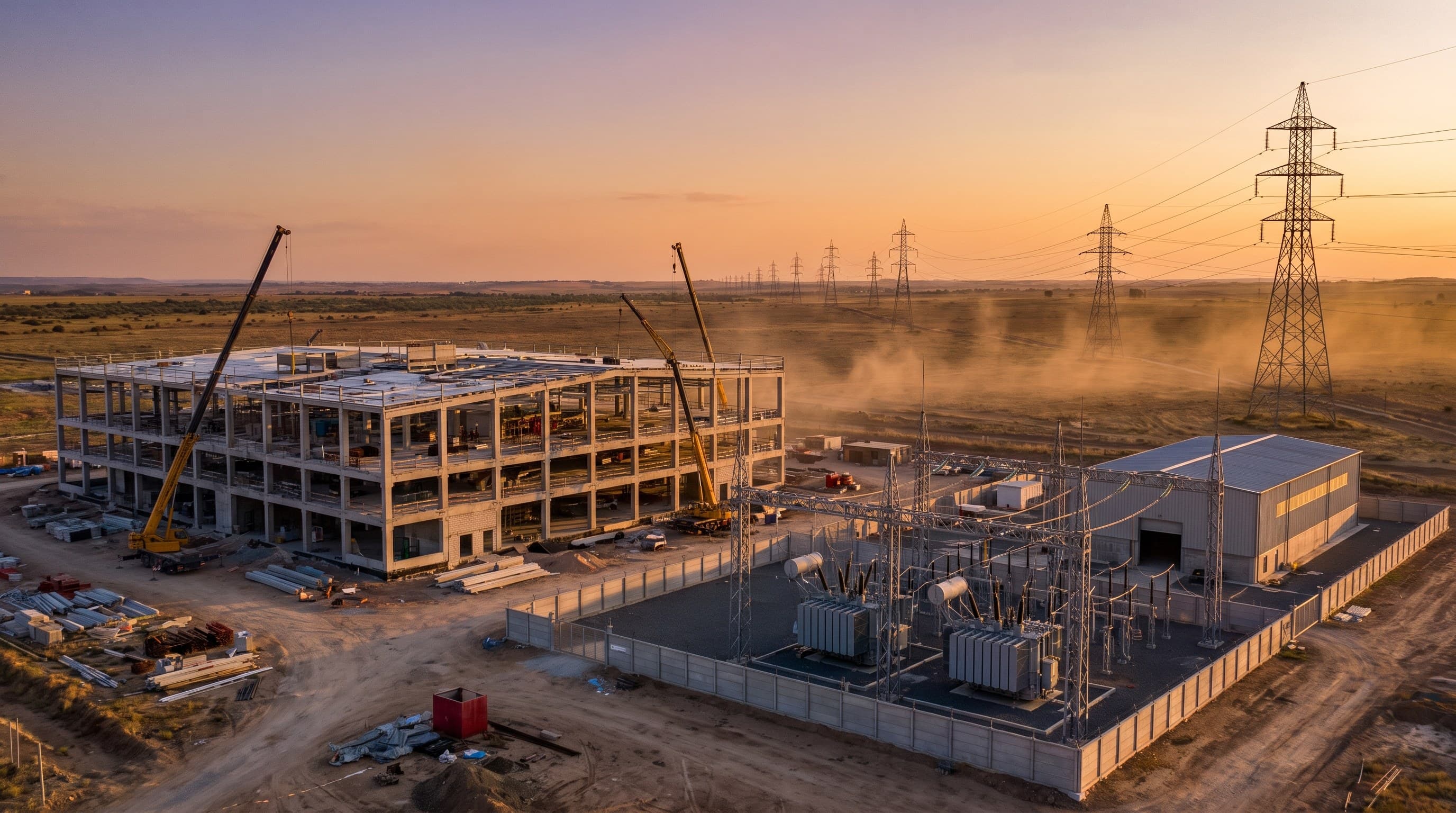
The reason that hole is so difficult to fill has nothing to do with money, and nothing to do with chips. On a screen artificial intelligence has no mass. On the ground it is a construction project: foundations, structural steel, copper, chillers, fibre, transformers, hectares, planning consent, and electricity in quantities that reorder a regional grid. Silicon with no power behind it is inventory. A hall with no connection is a shed. Software has become construction, and construction has always had to settle a question software never faced — whose name is on the deed?
Consider what is genuinely scarce. Permission takes an average of thirty-two months across twelve member states; the Act would like eighteen by 2030. The Netherlands is sitting on connection applications totalling something near thirty-eight gigawatts. Denmark stopped accepting them at around sixty. In the established European markets, land that already has power attached trades near €2.26 million for each megawatt, having risen by more than four fifths in four years.
None of that behaves like a software market. It behaves like a waiting list — and waiting lists are won by whoever controls the bottleneck, not by whoever builds the better product.
It is also worth asking which part of the asset actually keeps its value. Silicon ages fast: architectures turn over, densities climb, cooling regimes change, and this year's accelerator is next year's second tier. Consent, by contrast, does not expire. Transformers outlast the equipment they feed. A site with land, power, fibre and local agreement gets stripped and refitted over and over. Hardware is stock. The connection is the estate.
And then there is the transaction record, which is not opinion but public fact, and which I find genuinely difficult to read. France built Data4 and AXA sold it to a Canadian manager. Norwegians built Green Mountain and it went to an Israeli buyer. atNorth, out of the Nordics, moved to Swiss hands and on again to a Canadian pension fund alongside an American operator. Ireland's Echelon sold half of itself into American capital. A German-Norwegian venture, AQ Compute, now answers to an American majority.
Every one of them made in Europe. Not one of them controlled from Europe. Where European institutions turn up at all, they turn up holding minority positions, arriving once somebody braver has already absorbed the risk.
The foreign buyers in that list are not the problem. The empty European chair is.
This is where a European story becomes a Ukrainian one, because the inputs Europe is running out of are the ones we have.
Generation, including the largest nuclear fleet on the continent. Gas storage larger than anyone else's. Land. An engineering corps that has spent four years holding a grid together while it was being shot at. And a frontier with the market that is running short. What is missing here is capital at the stage it matters, and the stability capital insists on before committing.
Europe holds the money and cannot find the megawatts. Ukraine holds the megawatts and cannot reach the money. That is not charity. It is a transaction, and transactions are decided by their terms.
And the terms are being fixed right now, not at some later negotiation. Reconstruction finance lands precisely as this layer is assembled — the connections, the sites, the substations, the land. Whoever holds paper on those at the end of the decade holds the earning assets of this country for the half-century that follows.
Europe's experience is on the table in front of us, free of charge, and its lesson is specific. A country can build the infrastructure, host it, power it, staff it, permit it, and pay for the grid reinforcement out of household bills — and finish the process owning almost none of it. Nobody would file that as a failure. Capacity climbs. Investment lands. Employment rises. Every rule is obeyed. It looks like victory from any distance, and the only column nobody thought to keep is the one recording who owns the result.
So this does not end in a demand for purity, and it is not an argument against foreign money. Nobody builds this alone and Ukraine will not be the exception. The conclusion is smaller and more awkward than that.
Ownership of the physical layer has to be settled in the terms before the capital lands, because once it lands the structure is fixed. Whose name is on the site. Whose name is on the connection. Who holds the operating company. What proportion of the value created by turning a bare parcel with a grid application into a working two-hundred-megawatt campus remains with the country that provided the ground, the power and the people.
Europe settled the legal question and left the ownership question to whoever turned up holding the cheque. Their assessment is public. We can read it before we repeat it.